
Neural Programming: A New Paradigm For Radio
A neuroscience-driven framework for rethinking radio programming—introducing “neural programming” to optimize music scheduling, increase listener engagement, and modernize radio through data-informed creative decisions.
Over the past year, our team at Super Hi-Fi has been compiling a comprehensive collection of recent cutting-edge neuroscience research regarding how people perceive music experiences. Specifically, we’re interested in any available scientific data on how to use music selection decisions to drive more listening overall, and to drive more satisfaction with the experiences consumers have. This is all a part of an AI research project we’ve been running, primarily to build a new layer of capability in our scheduling AI, called Composer.
Basically our goal is to deliver the world’s most intelligent scheduling AI for radio and digital music companies, and in order to do that, we want to ensure that Composer is informed by the best practices found in music and engagement research. The result of all that work is something we’re testing right now, and which we’ll launch sometime in Q1 of 2026, and it’s going to be truly amazing when we do.
Along the way, however, we realized that much of the radio programming ecosystem is lacking access to the data that we’ve come across, and we started to wonder if the information we’ve been compiling could benefit any music programming approach, even if it doesn’t use our advanced AI to generate the outputs.
In other words, what if there was a way to improve listening trends by just modifying how we’re approaching manual scheduling structures right from the start of the process? That question sparked a separate work stream, one that we’ve worked to summarize here in this article.
Our goal here is to start a conversation; to tee up some options for how you might experiment with these ideas; to provide a step-by-step guide for getting started; and to give you some insight as to how we think about problems at Super Hi-Fi, and what we’re doing to solve them.
THE PROBLEM
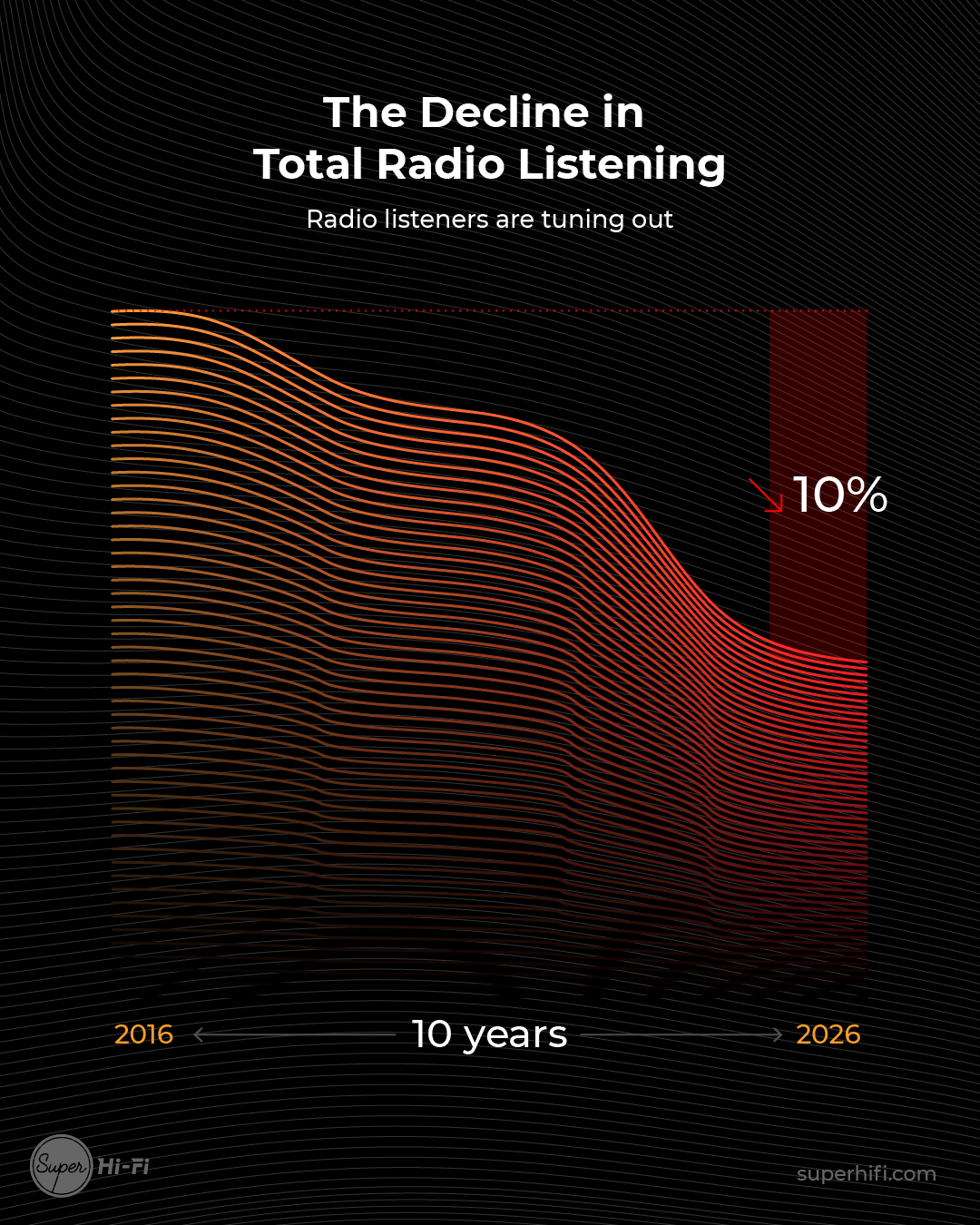
Radio listeners are tuning out. Over the past 10 years, consensus data indicates a 10% drop in total listening, and as we all know the trend is not stopping. Our collective goal as an industry needs to be to slow that trend down, to lean in to what makes radio different and valuable, to keep people listening for longer and to ensure that the listeners are maximally satisfied after doing so.
The digital streaming services do this very well, and they do it with data. They are constantly measuring real-time listening statistics, and adjusting their algorithms to accommodate what they’ve learned. They also do it with science, working to use whatever neuroscience research is available, or generating their own, and applying those lessons to their music discovery solutions.
Within broadcast radio, we don’t have much real-time data to work from (although that might change as we start using our own streaming data more effectively). But we DO have the opportunity to be influenced by the same science that the streaming music services use as a mechanism for driving better results.
When we assessed all of the information, what we basically found is that radio programming today really isn’t a science per se. From everything that we know about radio programming, it is a skill and artform, backed by a heritage and driven by goals for specific outcomes.
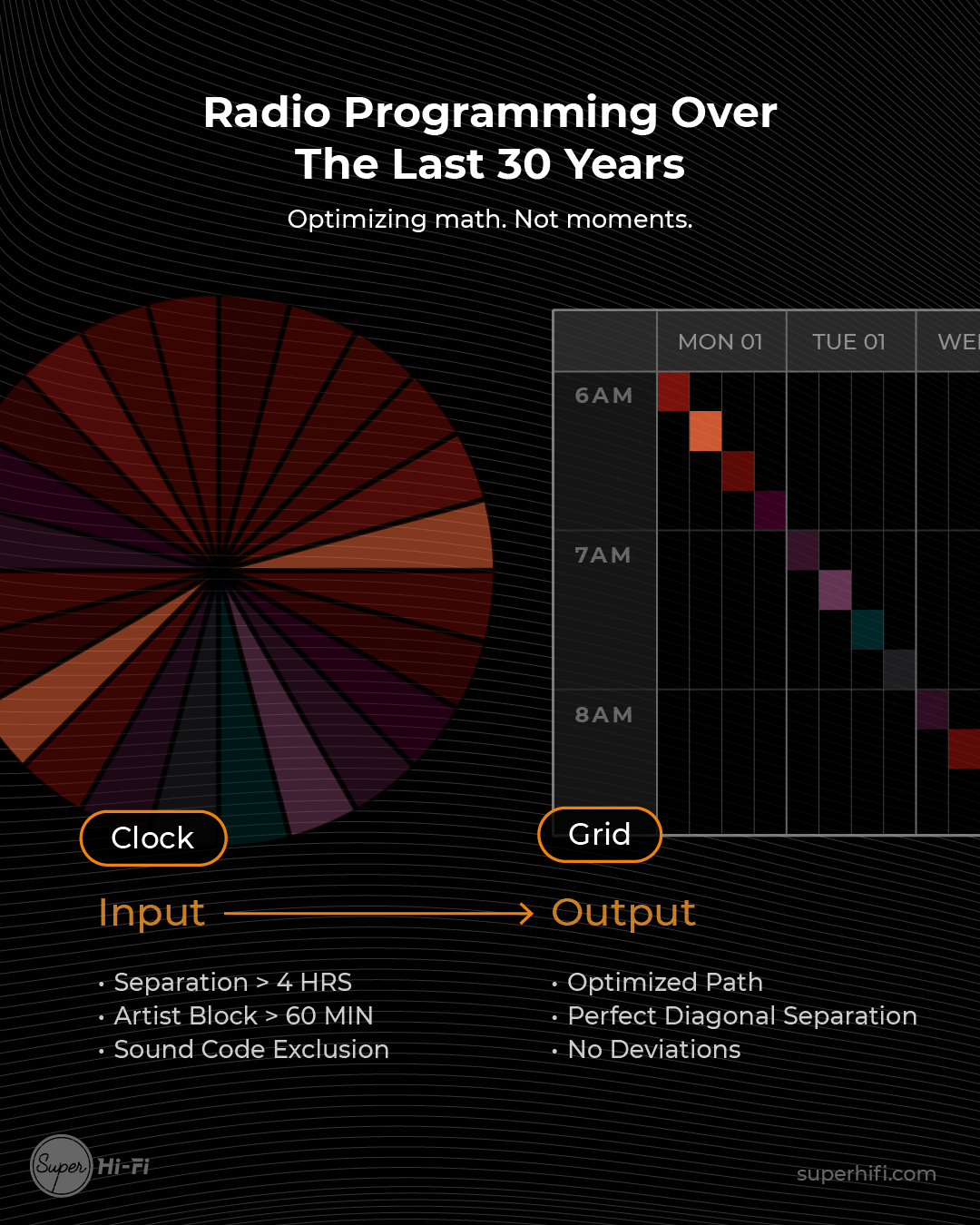
In many ways, today’s programming is the same as it was 30 years ago. Think about how you set up your category structure. You have a set of categories that you are looking to divide up in every hour on a pizza chart. Then you add in what we would call Negative Rules (artist separation, sound code separation, etc.), and if you look at your rotation analysis you are aiming for a clean diagonal line down the screen. Perfect separation. Every scheduling system is designed to support this method, every feature created to make this process easier.
To get the perfect rotations.
The thing is, rotations are essential for managing inventory exposure over specific hours, but listeners don’t experience hours in a single sitting. Listeners experience a continuous stream of Prediction and Resolution in the moment, with a
natural gravitation toward dopamine responses. Give them the proper balance of these cognitive triggers and they’ll reward you with more listening. But get it out of whack and you’ll lose them quickly. Summarized, what we’re doing here is a Neural approach to manage our listeners’ “State”.
State is simply the emotional vibe of our listener in the exact moment they’re tuning in. It’s not about the song’s chart history or its category; it’s about the specific feeling (excitement, comfort, energy) that a track delivers right now. We’ve spent decades managing the math of rotations, but listeners don't hear math; they feel moments. Managing State is about taking control of those moments, curating the sequence not just to separate artists, but to guide the audience’s mood and keep them emotionally locked in. That’s the Neural approach we’re looking to take here.
Here’s a summary of the differences between traditional methods and a Neural approach:
The Programmer vs. The Listener
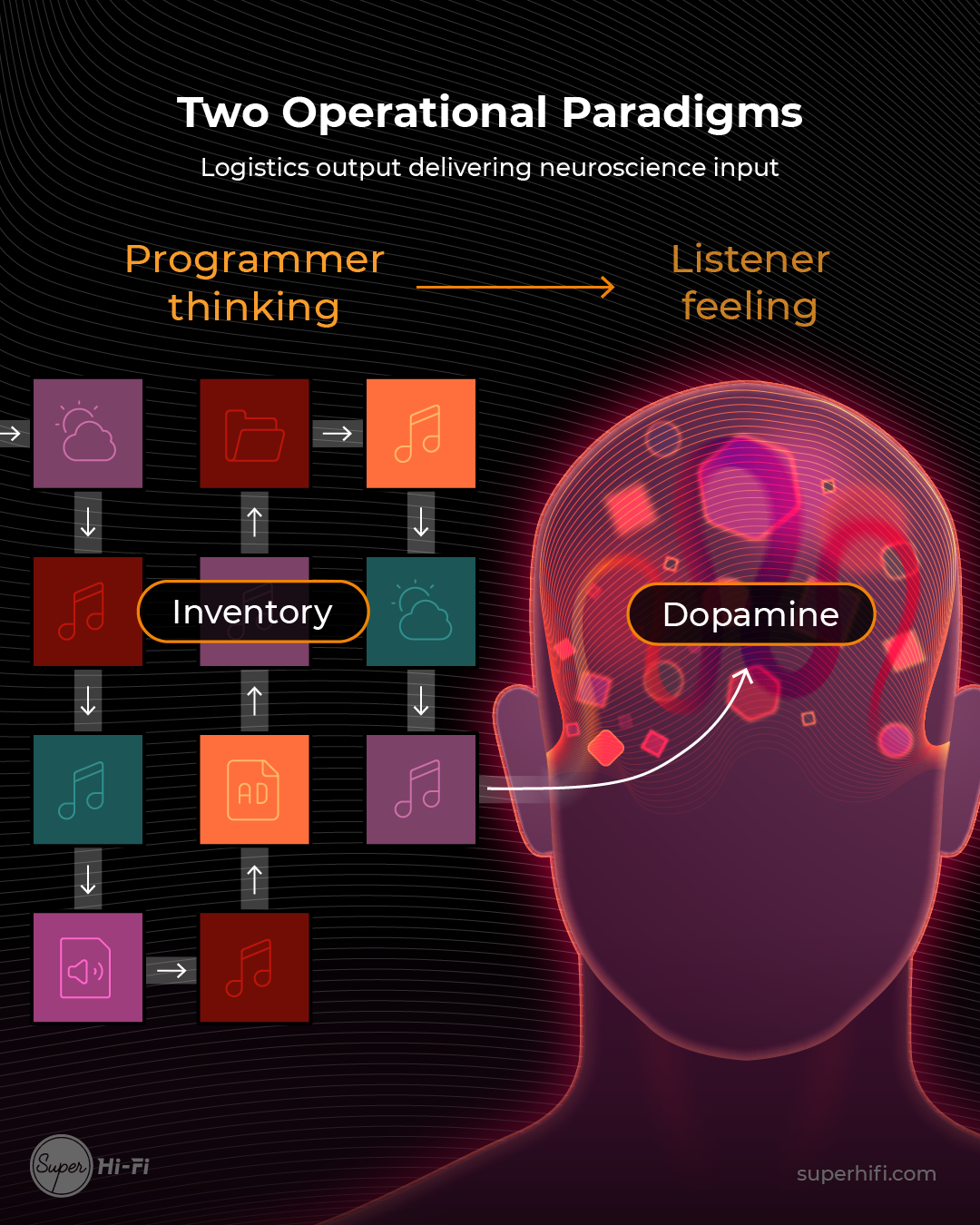
1. How Programmers Think Today (The "Output" Model): Programmers currently act like Warehouse Managers. They focus entirely on the Station's Output (The Log).
- The Goal: Optimization of Inventory.
- The Metric: Exposure (Spin Counts, Category Turnover, Separation rules).
- The Logic: "If I distribute the songs mathematically evenly, the result will be good."
- The Flaw: This assumes the value is inherently inside the song. (e.g., "This is an 'A' song, so it works anywhere.")
2. How Listeners Actually Feel (The "Input" Model): Listeners act like Dopamine Seekers. They focus entirely on Their Brain's Input (The Stimulus).
- The Goal: Optimization of State.
- The Metric: Reward Error (Dopamine release via Prediction & Surprise).
- The Logic: "I don't care about your rotation math; I care if this sequence regulates my energy and makes me feel safe or excited right now."
- The Science: Max Planck research proves that the value of a song is context-dependent. An "A" song played at the wrong arousal level (Input) is perceived as "noise" or "stress," regardless of its spin count (Output).
The Simple Summary: We have spent 40 years optimizing the Signal (Rotation curves, category separation). The new research says we need to optimize the Effect (Dopamine release, trust, and arousal).
The Old Way: Managing a Playlist (Logistics).
The New Way: Managing a Psychological Loop (Neuroscience).
THE PARADIGM SHIFT
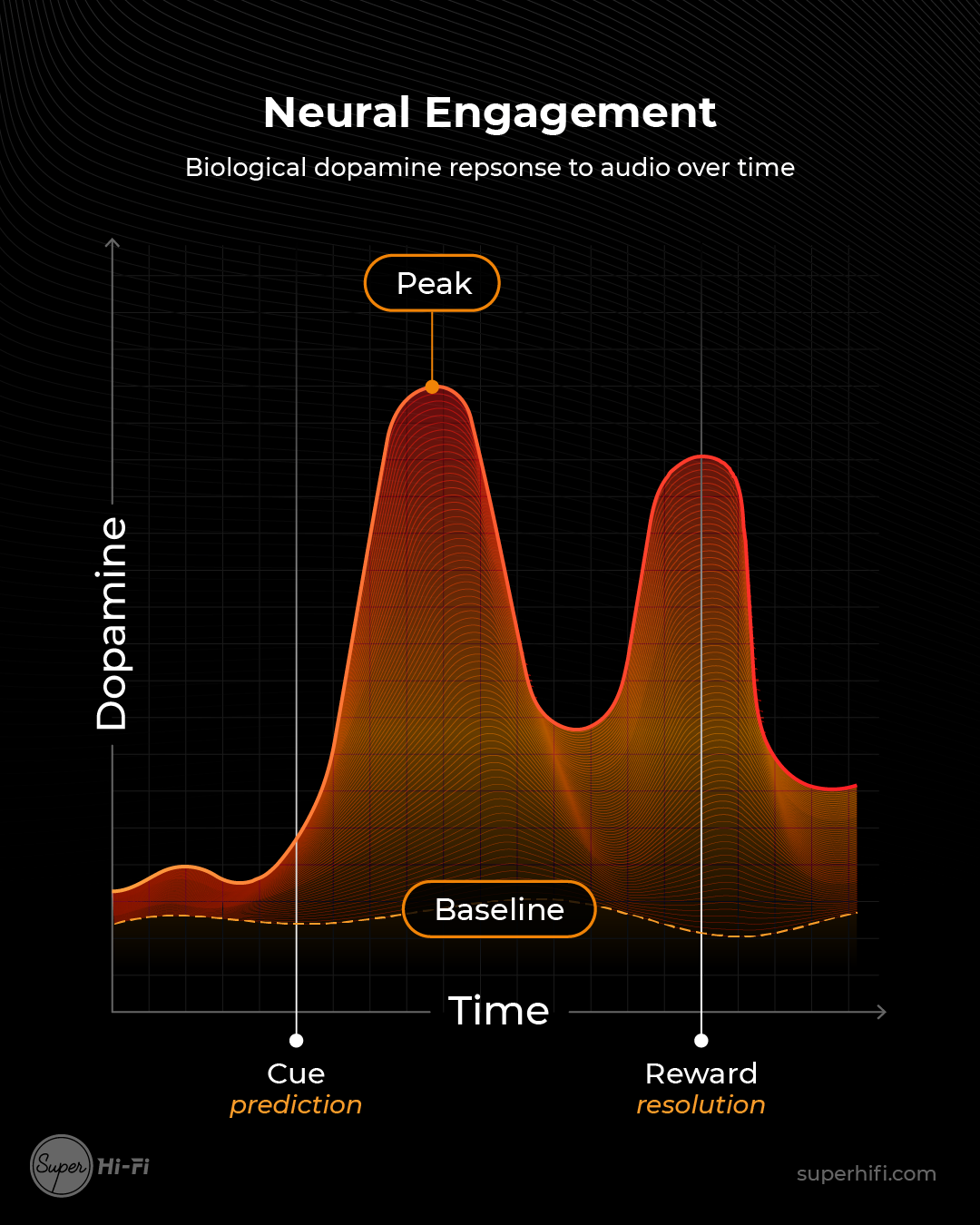
There’s an extremely important lesson to be learned from all of the compiled research, and it’s the crux of every recommendation being made here: We’re not just in the radio business. In fact we are actually in the business of generating dopamine responses.
Neuroscience has demonstrated time and time again that the human brain is fundamentally wired to seek this specific neurochemical reward. Dopamine is the biological currency of engagement. If we can trigger it, they listen longer; if we don’t, they leave. But here is the catch: Neuroscience also dictates that you can’t have a “high” dopamine response without first providing a “low” reference point.
That’s because your brain doesn’t measure value in absolutes, it measures value in contrast to expectation. This is important, because if we want to set the highest dopamine to generate the highest satisfaction with our station listening experience, then we need to fully understand how to set up the right conditions for such a response.
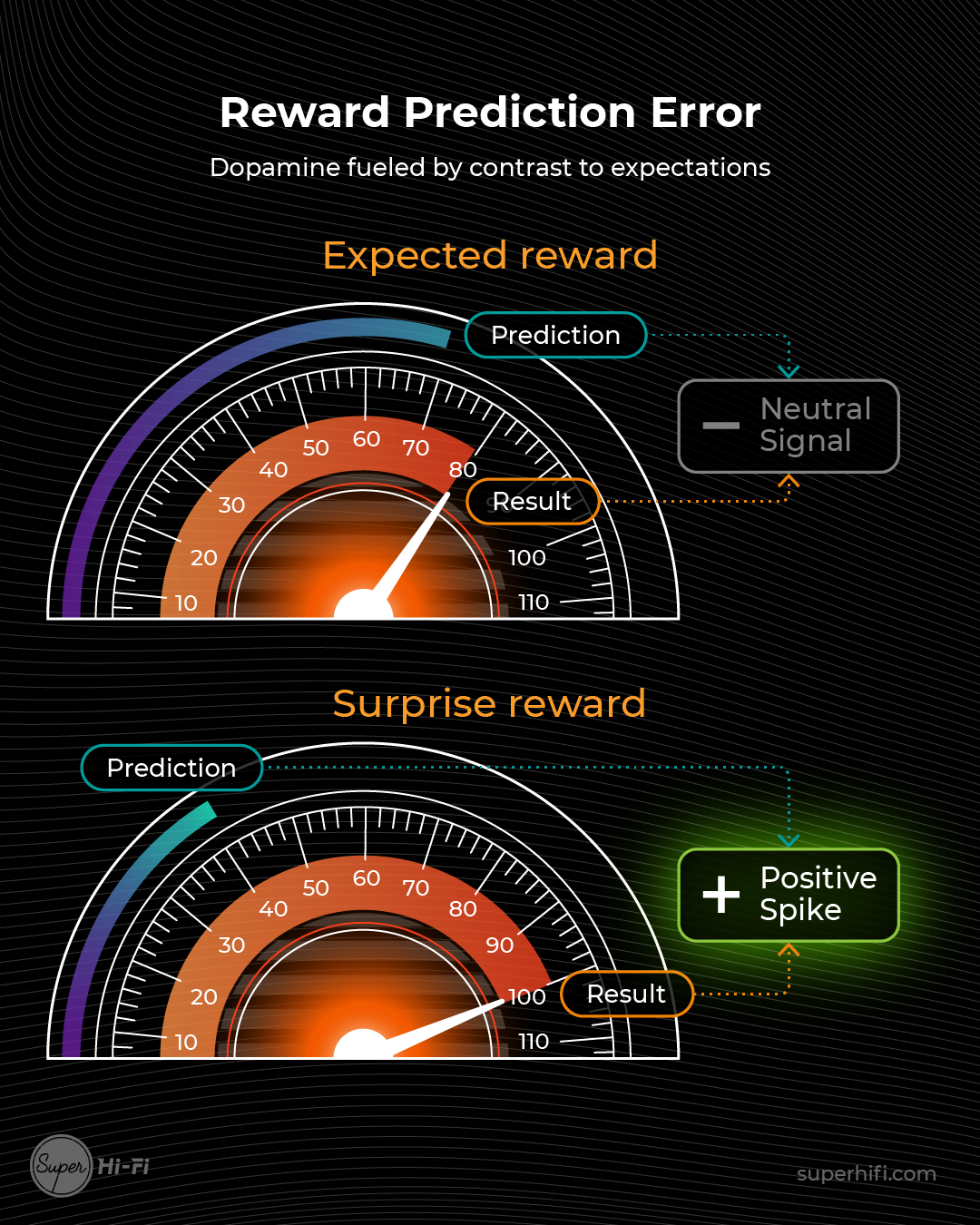
And the core equation for that dopamine response is driven by what is called Reward Prediction Error (RPE): Dopamine Response = Actual Outcome – Predicted Outcome. Read that twice. It’s the key to the rest of the model. Here’s a very simple example of how that works:
Scenario A: The "Broke" Listener
- The Prediction: You reach into your pocket expecting to find nothing ($0).
- The Actual: You find a $100 bill.
- The Math: $100 (Actual) – $0 (Expected) = +100 (Massive Dopamine Spike).
- Result: You feel thrilled.
Scenario B: The "Millionaire" Listener
- The Prediction: You are used to seeing $100; it's your baseline normal state ($100).
- The Actual: You are handed $100.
- The Math: $100 (Actual) – $100 (Expected) = 0 (No Dopamine Response).
- Result: You feel nothing.
A $100 find is high if you’re broke, but low if you’re a millionaire. It’s the difference in predicted outcome that drives the response.
That model for managing dopamine is used almost everywhere you look. Without you even knowing it, your dopamine response system is being constantly manipulated by some of the smartest and most creative people across media, advertising, fashion, gaming… even the food industry. Over decades, the neuroscience has made its way into countless industries. Radio is just late to the game.
Let’s look at the biggest movies of the past 50 years: how do they manipulate your dopamine response? Well, think about it… there isn’t a single one that doesn’t have a manufactured 'low' built in. This isn’t just drama, it’s biology. The 'low' crashes your expectations, which physically clears the deck to make the eventual 'high' actually feel like something.

Star Wars, maybe the most widely cited example of this in moviedom, uses this with surgical precision. The 'lows' are the ordeal of the trash compactor and the failure-moment of Obi-Wan’s death. Those moments lower the baseline. Then comes the high-risk trench run, followed by the massive payoff when the Death Star explodes. BANG! Dopamine hit. Now, imagine a different story: Luke just gets in a ship, flies up, pushes a button, and flies back down for a beer. No low, no failure, no risk. It’s boring and it’s unsatisfying, because without those context points, your brain simply doesn't issue a reward.

This is the Prediction and Resolution model that we referenced earlier. Think of almost any other huge blockbuster, and you’ll find the same pattern: The Avengers; The Lion King; Rocky; Erin Brokovich; The Matrix… and on and on. You think you’re watching a movie, but what you’re really watching is a well constructed dopamine response engine. Prediction and Resolution.

Let’s keep going, just to ensure the point is made. The Apple 1984 ad, perhaps the most famous TV ad of all time. Dark, slow, monotonous overtones generate the ‘low’ expectations. A negative anchor. Then the hammer flies in and explodes the screen, with the payoff being the Mac, representing freedom. There was a pretty low Predicted Outcome. But a pretty powerful Actual Outcome. BANG! Dopamine hit.
Here’s a much more current example: on your social media feeds, the algorithm actually serves up average-to-lower quality content, to set the low Predicted Outcome. Then, they provide a “pull to refresh” option, which acts like a slot machine, and of course the next set of feeds is generally a much higher match to your interests. BANG! Dopamine hit.

For a final example, we’ll point to the phenomenon of misspelled and grammatically incorrect titles on video thumbnails. These have popped up in the past few years, with very obvious examples such as “Loose Weight FAST!”; or “Defanitely The Best Way”; or “Your Doing It Wrong”. Another example would be a thumbnail of a Playstation 5 on the screen but the headline “The New XBOX Is Here!”. These are frequently from credible, high-quality producers, so why the poorly edited thumbnail? Well, because it’s far from poorly edited, in fact it’s quite well thought out. The science here that they’re all accessing is called a Correction Impulse. Basically, they’re weaponizing your natural impulse to want to correct what you see as out of order.
Here’s what’s interesting: for those misspelled videos, the click through rate is actually quite a bit lower, by up to 70%. But engagement, especially with commenting, goes way up, by an average of 500%! So fewer people clicking in, but significantly more commenting when users did click in. Why so much engagement? Because the impulse isn’t to just watch the video per se. The impulse is actually to correct the error, which is only achievable by commenting, which does what? That’s right, the commenting on an error drives a dopamine hit, because the error forces a psychological Low, making the corrective comment feel like an explosive High, purely through the power of contrast.
(BTW, you’d think with 70% fewer clicks nobody would produce these kinds of examples. But the engagement is so high that it drives the algorithm to show the thumbnail to more people, so in the end the total number of views will still go up even if the click-through-rate percentage goes down. Smart.)
This model is everywhere. All we’re doing here is applying the same skills, and the same science, to the radio experience. We’re working to craft a neural narrative that generates meaningful impact on the people that listen; we’re working to drive a dopamine response that leads to more listening.
NEURAL ECONOMICS
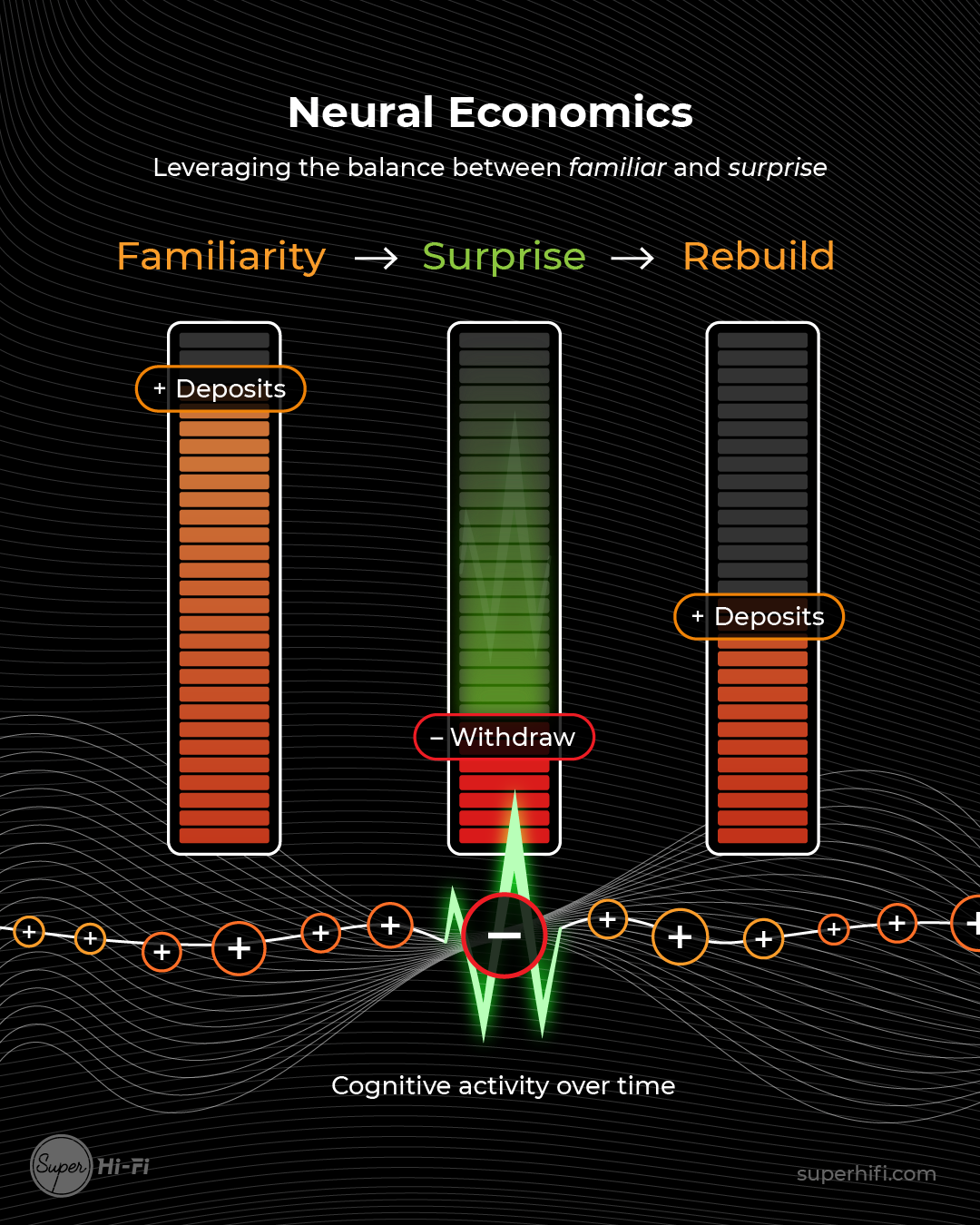
Okay, so we’ve laid out the basics of how the neuroscience works, and outlined the strategy for how to use that knowledge to manipulate dopamine responses. Next, we need to translate those principles into a framework for how to apply this directly to radio programming.
The way we’ll do this is to simplify the process into a new, easy-to-follow structure we’re going to call “Neural Economics”. This is going to make it much easier to understand how our efforts are likely to impact listeners, and it’ll give us a manageable method for controlling the outcome. Basically, if you can balance a checkbook, you can master the art of Neural Programming.
Let’s think about our listeners as a bank account, only instead of dollars what we’re budgeting for here is Cognitive Uncertainty. Remember, our listeners want that dopamine hit, and the way we give it to them is by balancing the ‘lows’ (Predictions) against the ‘highs’ (Resolutions) in a well managed formula. Our Cognitive Uncertainty Budget is how we optimize between those two ends of the spectrum, and our goal is to ensure that we’re hitting the mark. In economic terms, we’re looking to make the right moves in order to ensure the highest Return On Investment.
There are three distinct economic drivers of our Cognitive Uncertainty Budget, each of which represents a different aspect of how we’re going to manage our dopamine account:
- Predictability is a “Deposit” (Safety/Trust)
- Surprise / Novelty is a “Withdrawal” (Cognitive Cost)
- Resolution / Reward is the “Return on Investment” (Dopamine)
Simple, like managing a bank account. And just like a real bank account, there are rules of the market, and consequences for bad management:
- If we spend too much uncertainty without refilling the account (with familiarity/resolution), the listener goes bankrupt (anxiety/confusion) and tunes out.
- If we spend zero uncertainty, the listener gets no return on investment (boredom) and tunes out.
Our job is to manage the account to optimize the balance over time. Hence, Neural Economics.
PROGRAMMING OUR NEW STATION
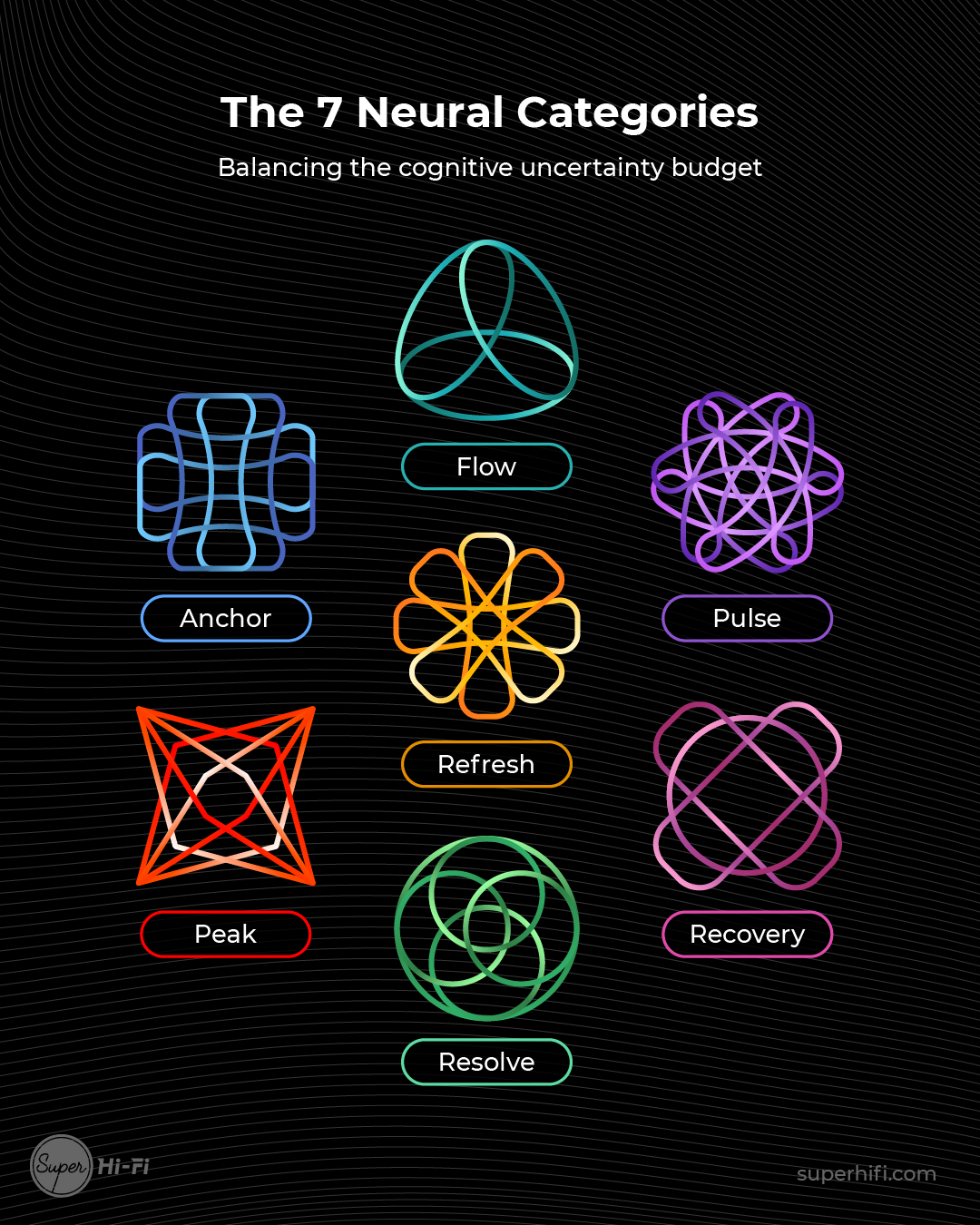
Now the rubber finally meets the road. We’re going to start by fusing all of this information into an entirely new approach to Categories. We’re throwing out the old model completely, and building 7 all-new, neuroscience-approved Categories that each reflect a different component of the Cognitive Uncertainty Budget.
Each of these requires thought and consideration as you fill them up, this is where the expertise of a human comes into play, because if you don’t choose the right music for the 7 new Categories, then the rest of the process won’t work as effectively.
Remember, we’re not really scheduling Music, we’re scheduling cognitive States:
- ANCHOR: Supports Stability & Confidence. High familiarity, low cognitive strain, fast reward (low boredom).
- FLOW: Supports Perceptual Fluency. Moderate familiarity, very high processing ease, stays in a consistent Energy/Mood band.
- PULSE: Supports Curiosity & Stimulation. Novelty injection (spends attention budget).
- RECOVERY: Supports Relief & Comfort. Immediate reward payoff (high familiarity, very low cognitive strain).
- REFRESH: Supports Attention Renewal. Reduces boredom by changing texture without adding high cognitive strain.
- PEAK: Supports Maximum Emotional Impact. Engineered “wow” (very high expected pleasure for the target time of day).
- RESOLVE: Supports Satisfaction & Closure. Satisfying, familiar, primes the audience for re-entry into the loop.
These are our new primary Categories. Let’s go a little deeper, so we can start to fill with the right music for whatever format we’re trying this on. Don’t think in terms of “Power Gold” or “Recurrent” anymore. Try to think in terms of Economic Function. Does the song fill the account, or spend the budget?
STATE A: ANCHOR (The Deposit)
- Neural Goal: Establish immediate relevancy and safety. Confirms: "You are listening to the #1 Station."
- Uncertainty Cost: Zero. (This is your currency).
- Characteristics: The absolute biggest songs in the world right now (Power Currents). Ubiquity: The listener expects to hear this song.
- When to Schedule: Top of Hour, and immediately before or after a "Pulse" track to subsidize the risk.
STATE B: FLOW (The Low-Cost Sustain)
- Neural Goal: Maintain the "Hit Music" vibe without the burnout of an Anchor or the strain of a Pulse.
- Uncertainty Cost: Low. (Maintenance Fee).
- Characteristics: "Developing" hits or songs on their way down from Power. Energy: Moderate to High. Fits the pocket of the station sound perfectly.
- When to Schedule: Between Anchors to extend TSL (Time Spent Listening) or to bridge two high-energy events.
STATE C: PULSE (The Expenditure)
- Neural Goal: Trigger Dopamine via Novelty (Prediction Error). Provide "High Novelty Music" and FOMO.
- Uncertainty Cost: High. (This is a Withdrawal of listener patience).
- Characteristics: Brand New Music. Breaking Hits. High curiosity factor.
- Constraint: Creates cognitive strain (SU). Must be "sandwiched" by Anchors or Resolves to prevent tune-out.
- When to Schedule: 4-5 times per hour. Always protected by a safe song (Anchor/Recovery) on at least one side.
STATE D: RECOVERY (The Rebate)
- Neural Goal: The emotional "comfort food" that balances the "new food" (Pulse).
- Uncertainty Cost: Negative. (Immediate Refill).
- Characteristics: GOLD / THROWBACK (Songs 3+ years old). High Positive Valence. Nostalgia-based dopamine.
- When to Schedule: Immediately after a high-risk PULSE sequence to reset the brain's comfort level.
STATE E: REFRESH (The Texture Swap)
- Neural Goal: Prevent "Wall of Sound" fatigue. Stops the station from sounding like one long song.
- Uncertainty Cost: Low/Medium.
- Characteristics: Remedial variety. Texture Shift. Remixes, acoustic intros, or collaborations.
- When to Schedule: When the "Sameness" meter gets too high (usually mid-hour).
STATE F: PEAK (The Dividend)
- Neural Goal: Engineered Hype. The moment the station sounds "Larger than Life."
- Uncertainty Cost: Medium (Demands attention).
- Characteristics: Power Intros (Station voice mixed over the intro). Maximum BPM or dynamic build. Anthemic.
- When to Schedule: Start of a sweep (00:00) or coming out of a long stopset to wake the brain up.
STATE G: RESOLVE (The Closing Balance)
- Neural Goal: Satisfying Closure. Primes the brain for the commercial break or re-entry.
- Uncertainty Cost: Zero.
- Characteristics: RECURRENT. Hits from last year / 1-2 years ago. Extremely safe, tested, and burned-in.
- When to Schedule: The last song before a stopset, or used to "clean up" after a jagged Pulse track.
STOPSETS & THE "AD BREAK TAX"
One item that stands out is how an ad break is actually a massive Uncertainty Tax. The listener is being asked to pay attention for 3-4 minutes with no immediate reward. This is the most sensitive moment in any clock, it’s where we’re most likely to lose our listeners and we need to take a similarly thoughtful approach to handling these breaks.
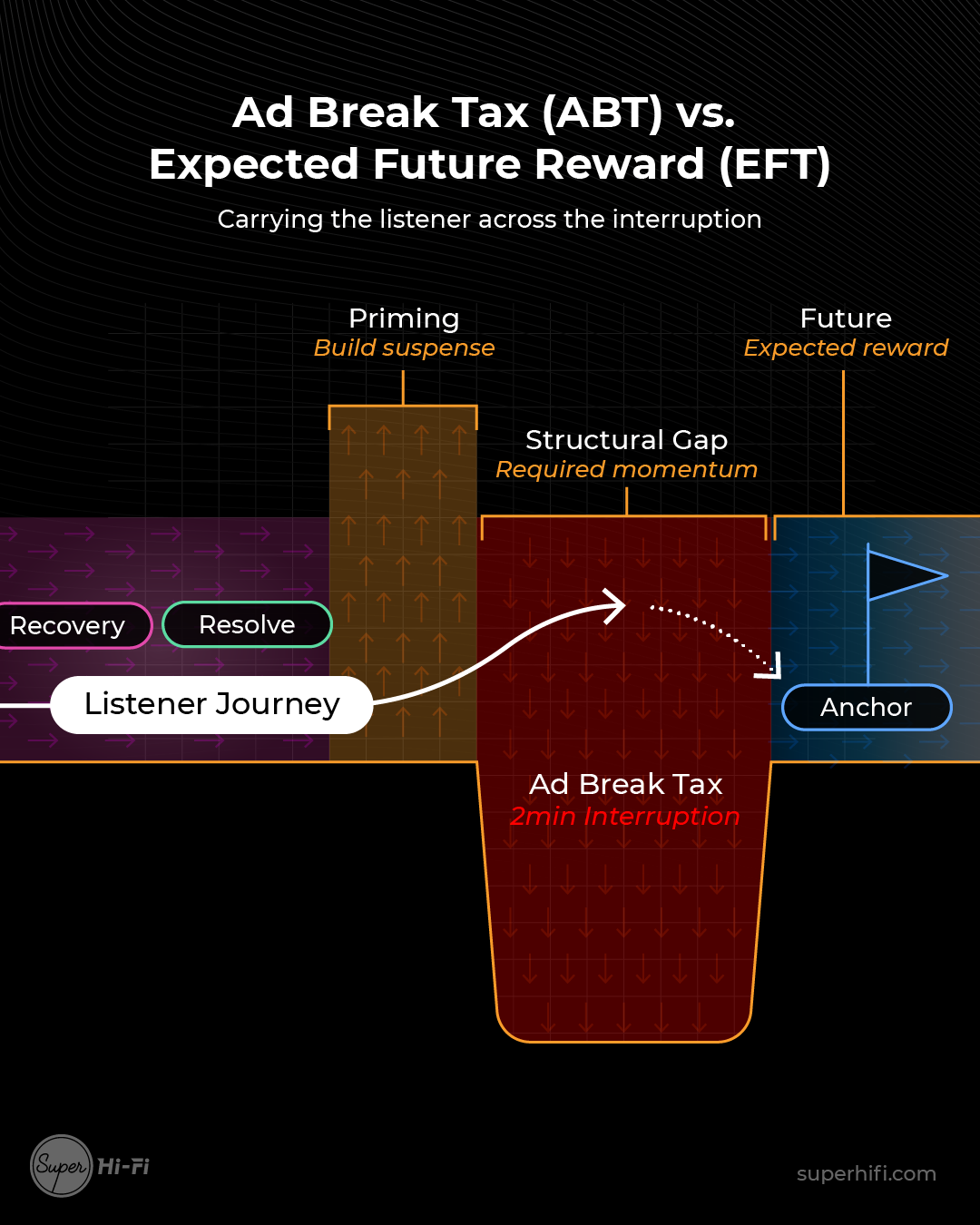
To put it into neuro-economics terms, we need to balance the Ad Break Tax (ABT) against the Expected Future Reward (EFR). If ABT > EFR we lose our listener. If EFR > ABT we’ll keep them into the next quarter hour.
The first way we’ll manage this is by leading into the break with a Resolve or a Recovery song. Each of these acts as a security deposit, it sets them firmly in a positive state enough to increase the probability that they will pay the ABT.
Next, we need imaging that reinforces their feelings of control. Specificity really matters here, because we are using Priming Principles to set the right conditions for what’s coming next. “Priming” is another neurocognitive management concept to guide listeners through ad breaks by creating unresolved suspense moments before the interruption. By opening a "mental loop", such as a cliffhanger or a promise of an immediate high-value reward, we condition the brain to focus on the future payoff rather than the current delay. This ensures the viewer's desire for closure is stronger than their urge to switch tasks.
To that end, we never want simple, undefined imaging. No more “We’ll be right back” messages. We want clarity here: “Much more music, after this 2 minute ad break”. “Coming up… [Song Name]”.
Finally, the song after the stopset is probably the most important song in the entire clock. You just asked for an investment from your listener, the next song is the Payoff. Get it right and they feel rewarded, get it wrong and you stole their time from them. For this, we want an Anchor song. High-recognition, low cognitive load. Get them back to it quickly, no lingering imaging or long unnecessary promos. They paid the ABT, get them right into the EFR as quickly as possible.
MICRO LOOPS
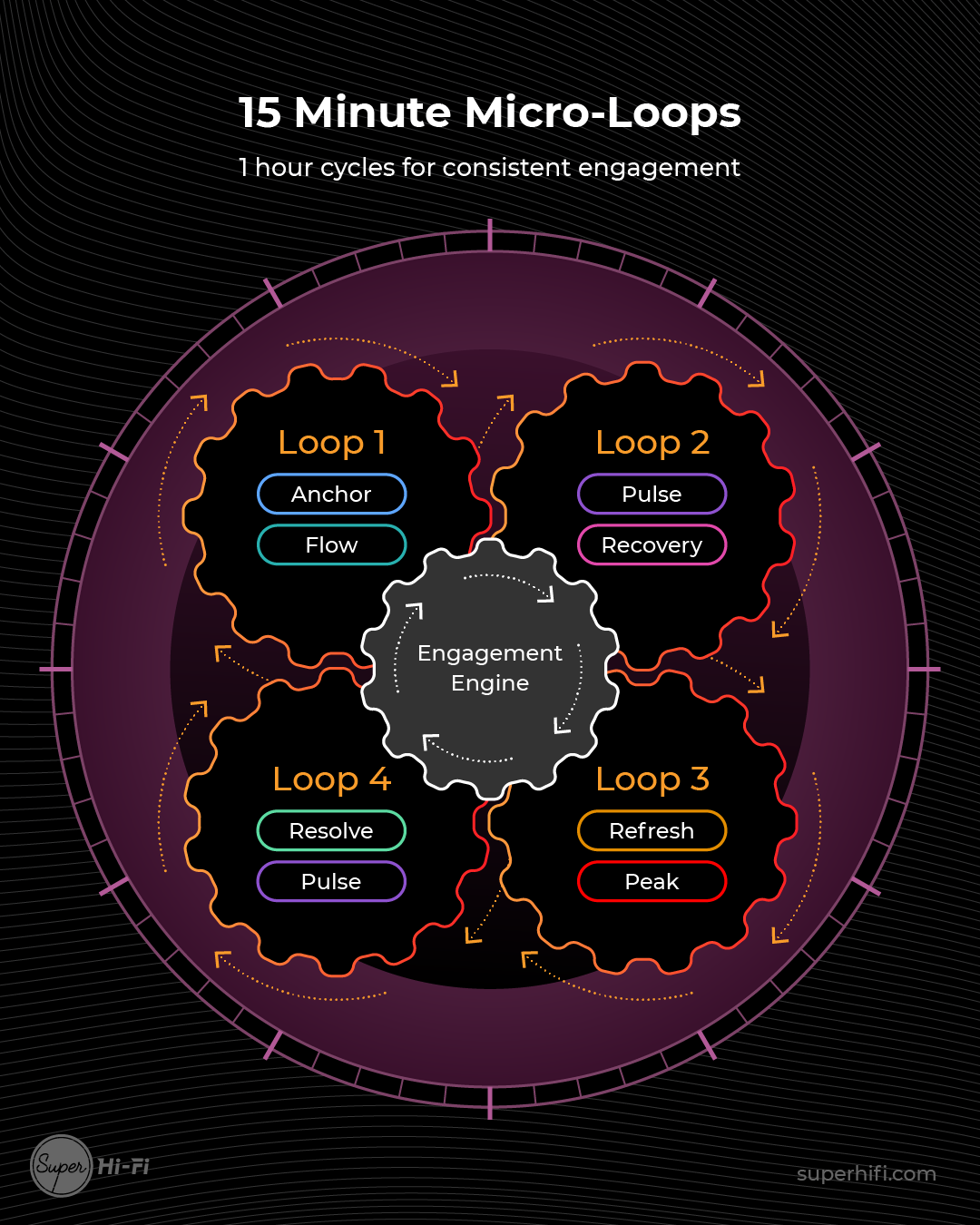
One item to take into consideration is that people don’t start at the top of an hour and follow along from there. Listeners tune in at completely random moments within any hour, based on an endless set of variables, and their listening patterns vary wildly from one another.
Because of this, there’s no simple way to map existing research on listening engagement directly onto a radio station. Services like Spotify start their ‘clock’ on an individual basis whenever someone starts their first song of the day, and so they can then work to provide highly personalized user journeys that use the research directly to influence listening trends.
In radio, we have a one-to-many experience that is being randomly grazed by listeners. A scientist might refer to this as “Stochastic Exposure”, where your listening starts based on probability, not fixed timing. To solve this conundrum, we’re not looking at a clock as a pre-determined period of time (such as a single hour), but instead we are breaking our clock models into “micro loops” of experiential design.
These 10-15 minute journeys are designed to ensure that no listener is ever too far away from a dopamine reward moment in their listening irrespective of when they joined the audio. Within each of these micro-loops, we’ll apply our Neural Economics approach, to ensure that we’re managing each listener’s neural state appropriately to drive more listening overall.
DAYPARTED CLOCKS
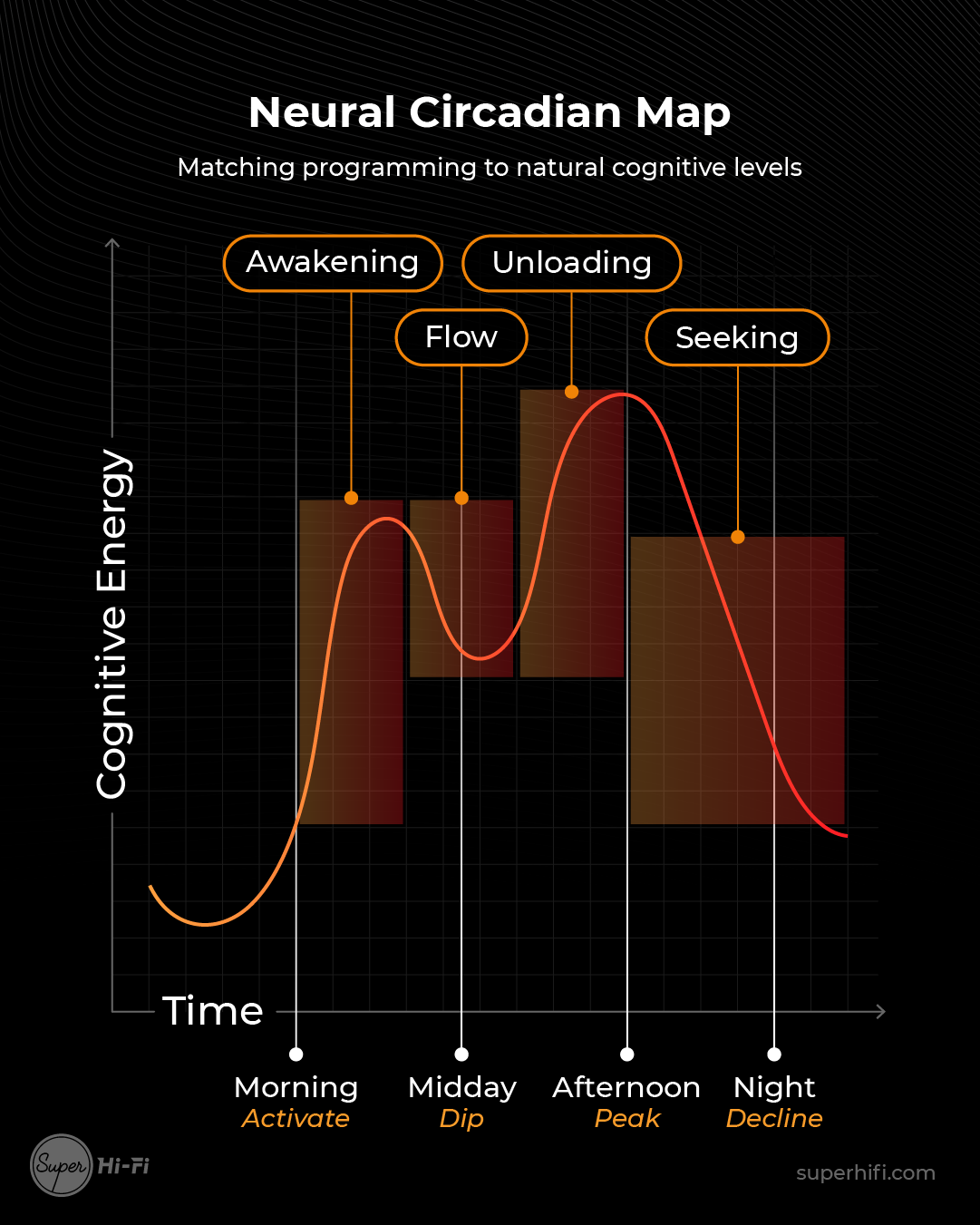
Finally, we have to be sensitive to dayparts, and align our clock grids to reflect how we naturally gravitate through State-changes over a circadian cycle. Each high-level daypart represents a specific neural default mode, and the suggested clocks are each designed to support the listening experience that the studies suggest would lead to the maximum time spent listening.
Our suggestion is to try these out. Your categories should already have been built, based on the song criteria laid out above. Now we need to build out the clock structure based on the map below.
Before we get started, we’ll list out a description of each neural function, to provide a map of how we’re using each moment to manage state, and to manage eventual reward:
- Frisson: Triggers an autonomic arousal spike ("the chills") to heighten emotional salience and snap the brain out of autopilot.
- Prediction Error: A dopamine injection caused by positive surprise; tags the content as novel "Cultural News".
- Processing Fluency: High ease-of-cognitive-processing that lowers mental load and signals environmental safety (The "Anchor").
- Homeostasis: A psychological reset that returns the system to equilibrium, often utilizing autobiographical memory (Nostalgia) to reduce stress.
- Cognitive Offloading: A necessary reduction in active processing (a "brain break") to prevent sensory overload.
- Flow State Support: Audio masking that occupies the conscious mind just enough to prevent distraction, allowing for sustained focus on external tasks.
- Dishabituation: A sudden texture shift that resets auditory attention and prevents neural adaptation (tuning out due to sameness).
- Cognitive Closure: The resolution of narrative tension that satisfies the brain's need for completion and mitigates the "Zeigarnik Effect" (the mental itch of unfinished tasks).
1. MORNING DRIVE: The "Cognitive Awakening" Protocol
The Neuro-Goal: Rapid Processing & Relevance. The brain is experiencing the Cortisol Awakening Response (CAR) and demands "news" (relevance) but cannot handle high friction (weirdness).
The Budget Strategy: High Density, Protected Novelty.
Uncertainty Budget (UB): Strict. Every Prediction Error (Pulse) must be resolved immediately by Processing Fluency (Anchor).
2. MIDDAY: The "Cognitive Flow" Protocol
The Neuro-Goal: Variance Reduction & Masking. The brain is in the Prefrontal Cortex (working). It requires "Acoustic Wallpaper" that minimizes Amygdala triggers.
The Budget Strategy: High Consistency, Low Friction.
Uncertainty Budget (UB): Zero. We cannot afford Prediction Errors that break concentration.
3. AFTERNOON DRIVE: The "Allostatic Unloading" Protocol
The Neuro-Goal: Catharsis & Ego Depletion Recovery. Willpower is exhausted. The brain needs to "vent" via Vagal Tone Stimulation (Singing/Shouting).
The Budget Strategy: High Amplitude, Reward-Heavy.
Uncertainty Budget (UB): Moderate. The listener is irritable. We use Prediction Error only if it is a "Cool" social reward.
4. NIGHTS: The "Dopamine Seeking" Protocol
The Neuro-Goal: Exploration & Reward Learning. The Prefrontal Cortex (Logic) powers down. The DMN (Daydreaming) activates.
The Budget Strategy: High Dynamic Range, High Openness.
Uncertainty Budget (UB): Loose. The brain is seeking Prediction Error. It wants to be surprised.
Note on Novelty: In this daypart, "Pulse" does not always mean a brand new release. It can be a "Discovery" track—a high-spice Gold or Deep Cut that creates Prediction Error because it deviates from the standard daytime safe-list.
THE RESULT

We’ve programmed a test Country station using these exact parameters, you’ll find the link below. Take a listen. What you’ll hear won’t surprise you, it’s a well-managed flow of music similar to what you’d hear on any well programmed Country station. But listen for longer, and you’ll start hearing the difference. It’s not a huge shift, but inside the subtle changes from a traditional clock, the differences start to add up. Remember, the tracks are being chosen based on their relationship to how your neural wiring is going to interpret the music over a length of time rather than their relationship to any existing programming techniques.
To be clear, we’re not framing this as the end-all / be-all for the future of radio programming. This is a really just first attempt at using cutting-edge science and research to drive a different set of decisions around how to capture more listening, and to deliver a more satisfying listening experience. Our assumption is that there will be more lessons to be learned, and more science to be studied and applied. But at least we have a strong starting point for you to work with, and we truly believe that the proper application of these techniques is going to help move the state-of-the-art for music programming further along.
Final note: the science itself is fairly complicated, but it really does work, and it’s the basis for many of the feature enhancements we have planned at Super Hi-Fi for the duration of the year. We believe that it’s going to make a big difference, both to our customers and to their listeners, and we can’t wait to share what we have in store.
.png)
.jpg)
.jpg)

